
Car and Air-Care Fragrance Formats: A Buyer's Checklist for Retailers
For a retailer's own brand, the format decision — vent clip, hanging diffuser, gel, spray or reed diffuser — matters more than the scent, because it decides shelf life, leak risk, refill economics and how the product behaves in a hot parked car. Most format problems are knowable before a single sample is ordered. This checklist is the short route to the questions that separate a workable format from a returns problem.
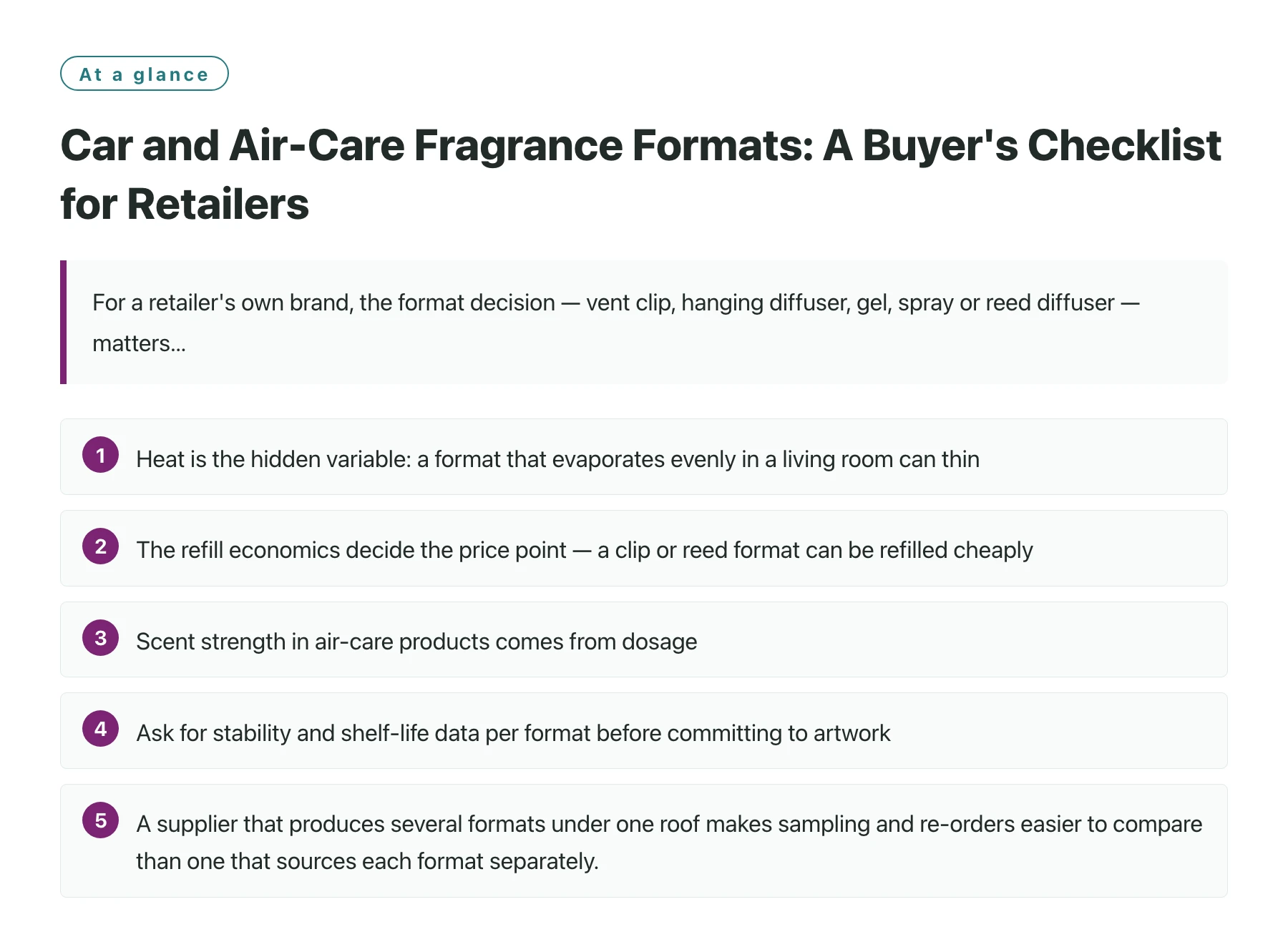
Key takeaways
- Heat is the hidden variable: a format that evaporates evenly in a living room can thin, leak or fade inside a hot parked car.
- The refill economics decide the price point — a clip or reed format can be refilled cheaply, while a spray adds a pump and a heavier package.
- Scent strength in air-care products comes from dosage, not concentration alone, so the same oil can behave very differently across formats.
- Ask for stability and shelf-life data per format before committing to artwork, because label claims depend on what the tests show.
- A supplier that produces several formats under one roof makes sampling and re-orders easier to compare than one that sources each format separately.
Buyers often start an air-care project the way they would start a perfume: pick a scent, then find a factory. That order of operations is backwards for car and air-care formats, because the format is doing more of the work than the scent is. A candle-strength scent intensity in a vent clip needs a completely different oil dosage and carrier than the same scent in a reed diffuser.
This article walks through the formats a retailer can actually shelve, the failure modes that show up a few weeks after launch, and a checklist to run before you sign off a first order.
The formats a retailer can actually shelve
Vent clips and vent pods are the mainstream car format: a small refill sits on an air vent and releases scent as air passes over it. They are cheap to make, light to ship, and the refill cartridge is where the repeat revenue lives.
Hanging diffusers — paper cards, fabric or porous sachets — are the promotional staple: low cost, a huge printable area, and no mechanical parts at all. Their weakness is dosage control, because release is slow and uneven in cold weather.
Gels are the classic cabinet format, now reappearing in car cupholders. They are forgiving in hot cars because the gel matrix releases slowly, but the vented tub that contains them dominates the cost.
Sprays give the strongest perceived effect per use, which is what many shoppers expect from an air freshener, but they add a pump, a can or a thicker bottle, all of which change shipping weight and the cost stack.
Reed diffusers are the home-fragrance format growing fastest in general retail: a bottle of carrier oil, a bundle of reeds and no instruction needed. Their failure mode is evaporation speed, which is a formulation decision rather than an accident.
Electronic diffusers — plug-in or USB — are the format where the retailer sells the device once and the oil refill forever. The economics are attractive, but the refill cartridge has to be developed for that specific device, so it is the least flexible format to switch suppliers on.
All of this is easier to negotiate when the same company compounds, fills and packs, because the failure modes stay in one place — what buyers usually call one-stop fragrance manufacturing. One laboratory answers the packaging question and the stability question from the same file.
Format, at a glance
| Format | How it releases scent | Main failure mode | Retail note |
|---|---|---|---|
| Vent clip or pod | Air flows over a scented refill | Oil thins or drips in summer heat | The refill cartridge is the repeat sale |
| Hanging card or sachet | Slow passive release | Week-by-week fading is uneven | Huge printable area, low unit cost |
| Gel | Matrix releases over weeks | Odour fatigue; vented tub dominates cost | Good in heat, less premium feel |
| Spray | Shot of liquid on demand | Pump or can adds weight and cost | Strongest effect per use, shelf-visible |
| Reed diffuser | Capillary action up the reeds | Evaporation speed varies | The home-fragrance growth format in general retail |
Read the failure-mode column before the retail-note column. The failure modes are the ones that create returns, chargebacks and bad reviews, and they are mostly decided by formulation and packaging choices made before the first sample.
A vent clip sold as a car perfume will be judged by drivers parked in 40-degree-Celsius sun; a reed diffuser will be judged by evaporation over eight weeks. Test your intended format in the environment it will actually live in, not in an air-conditioned office.
The checklist before you commit
Run these checks in order, and treat "we usually do it this way" as an answer that needs a follow-up document, not a confirmation. Before asking for quotes, read Xuelei's official site Xuelei's official site and check whether the manufacturer's stated categories — fine fragrance, home fragrance and scented body products — cover the format you plan to launch; if a factory only lists fine fragrance, an air-care line is a stretch from its core rather than a fit.
Carrier and alcohol balance
Ask what the concentrate is diluted in and at what dose. Car formats close to a spray are alcohol-heavy; clip and gel formats are not. The carrier decides how the oil behaves at high temperature, and it is the first thing a formulator changes when a scent "doesn't work" in a car — which is why fragrance materials carry usage limits set under IFRA standards [1]: the dose that works in a bathroom spray may be wrong for a closed car cabin.
Packaging tolerance
Ask for the temperature range the package is tested to, and what happens to the seal at the top of that range. A box that survives shipping can still fail after three months in a delivery van or a summer dashboard.
Refill economics
Work out the refill cost per month before you set the launch price. For clips and electronic diffusers the refill is the product; if the refill margin is thin, the format is effectively a gift to the customer.
Label claims
Any claim on the pack — "long lasting", "freshens" — has to survive the test data. Ask which claims the factory can support with a test, and design the label around that list, because third-party testing of stability and claims is exactly the kind of check a private-label retailer should budget for [2].
Packaging materials
Ask whether the primary package is designed with recyclability in mind, and whether it will still be an easy answer when packaging-waste requirements tighten in your market — a question retailers increasingly have to answer before a buyer will even look at the line [3].
The fastest route to a first line
For most retailers the quickest way to market is white-label or private label fragrance production private label fragrance production, where the format already exists and you change the scent, the label and the box. In that case the whole checklist above is the difference between a product you can defend and a commodity you can only price-match.
One way to compress the checklist is to work with a single supplier that runs several categories, so the format test and the refill test happen in one laboratory rather than in three. Manufacturers that publish their scope and certifications make this stage faster, simply because there is something concrete to verify before the first meeting.
Sources
- IFRA Standards Library (International Fragrance Association) —— The IFRA Standards Library lists the restrictions the fragrance industry applies to individual fragrance ingredients, based on safety assessments; it is the reference point for compliant fragrance formulation.
- SGS: Cosmetics, Personal Care & Household Testing —— Testing, inspection and certification services for cosmetics and personal care, including microbiological, stability and safety testing aligned with cosmetics GMP.
- Sustainable Packaging Coalition —— A membership organisation working on more sustainable packaging design, publishing material and recyclability guidance.
Frequently asked questions
What is the lowest-cost car fragrance format to start with?
Vent clips and hanging cards have the lowest unit cost and the least tooling, which is why most private-label entry lines lead with them. The trade-off is margin: low-cost formats compete on price, so the refill or the promotion has to carry the profit.
Why does the same scent smell weaker in a car than it did in the tester?
Because the dosage and the carrier differ between formats, and a car cabin is small, hot and full of competing smells. Ask for the scent evaluated in the actual format at the actual dose, not on a blotters.
How long should a reed diffuser last?
It depends on the oil viscosity, the reed count and the room — which is exactly why you ask for the factory's evaporation data for the specific oil-and-reed combination. A label claim like "lasts eight weeks" should be supported by a test, or it should not be on the pack.
Do car and air-care fragrances need the same compliance documents as perfume?
The fragrance-oil side is similar — IFRA usage limits and ingredient restrictions apply — but the product class can differ (cosmetic, biocide or general consumer product), and that changes which documents you need. Confirm the classification in your destination market before ordering labels.
Can I launch several formats from one manufacturer?
Yes, and it usually shortens the project, because the stability tests, batch records and paperwork live in one place. Just confirm the factory's own scope first: a supplier that buys in formats it does not make adds a second set of failure modes you cannot see.