
Verified · Updated today
Upgrade your cabinet airflow with high-performance enclosure cooling fans
Upgrading the airflow in the cabinet is like injecting a strong heartbeat into precision equipment. An industry analysis indicates that for every 10 degrees Celsius increase in the internal temperature of the cabinet, the probability of electronic component failure doubles. However, the high-performance enclosure cooling fans can reduce the temperature of hot spots by more than 15 degrees Celsius. Take a semiconductor factory in Shenzhen as an example. In 2023, it replaced traditional fans with high-efficiency models, increasing the heat dissipation efficiency of a single device by 40% and avoiding an average annual production halt loss of over 500,000 yuan due to overheating. This upgrade is not merely a technological iteration but also a risk control strategy, much like tying an invisible safety rope around key operations.
From the perspective of performance parameters, the air volume range of modern cabinet cooling fans can reach 50 to 500 cubic meters per minute, the static pressure is stable at 200 Pascals, and the noise value is lower than 45 decibels, meeting the ISO 14644 clean standard. A technical assessment in Europe shows that models adopting EC motor technology are 30% more energy-efficient than traditional AC solutions, with a power factor close to 0.95. For instance, after deployment in a certain data center in the Netherlands, the annual electricity-saving rate reached 25%, equivalent to reducing 120 tons of carbon emissions. This precise aerodynamic design is like a watch movement, achieving the optimal solution for energy flow within a limited space.
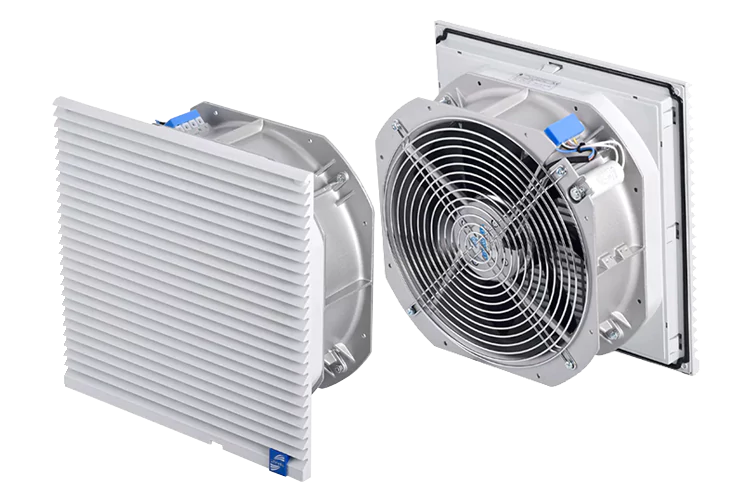 The return on investment model clearly shows that the average cost of upgrading to an industrial-grade cooling solution is approximately $300 per unit, but the payback period is only 12 months, with a failure rate reduction of up to 60%. According to the 2024 "Manufacturing Automation" report, enterprises adopting intelligent temperature-controlled fans have reduced their maintenance costs by 35%. For instance, a robot integrator in Shanghai has extended the lifespan of its fans to 80,000 hours through predictive maintenance. This is not merely an equipment update; it is a financial decision that transforms fixed costs into competitive advantages, much like installing an accelerator for operational efficiency.
In terms of reliability, high-quality fans have an average mean time between failures of over 60,000 hours, with a protection rating of IP54, and can operate stably in an environment ranging from -20 to 70 degrees Celsius. Case studies show that after upgrading the cooling system in a certain international bank's data center, the temperature fluctuation range inside the cabinets was reduced from ±10 degrees Celsius to ±2 degrees Celsius, and the equipment availability was increased to 99.95%. This robustness is like the immune system of digital infrastructure, maintaining a stable output even at peak load.
With the development of Industry 4.0, smart fans integrated with IoT sensors can monitor 12 parameters in real time, such as air flow speed and temperature distribution, achieving data-driven optimization. The market predicts that the global smart cooling market will grow to 8 billion US dollars by 2026, with an annual growth rate of 11.5%. Just as a global communication operator has applied in 5G base stations, the adaptive fan system has successfully reduced energy consumption by 20% while enhancing network reliability. By embracing this technological revolution, enterprises can not only gain immediate benefits but also gain an edge in the digital race.
The return on investment model clearly shows that the average cost of upgrading to an industrial-grade cooling solution is approximately $300 per unit, but the payback period is only 12 months, with a failure rate reduction of up to 60%. According to the 2024 "Manufacturing Automation" report, enterprises adopting intelligent temperature-controlled fans have reduced their maintenance costs by 35%. For instance, a robot integrator in Shanghai has extended the lifespan of its fans to 80,000 hours through predictive maintenance. This is not merely an equipment update; it is a financial decision that transforms fixed costs into competitive advantages, much like installing an accelerator for operational efficiency.
In terms of reliability, high-quality fans have an average mean time between failures of over 60,000 hours, with a protection rating of IP54, and can operate stably in an environment ranging from -20 to 70 degrees Celsius. Case studies show that after upgrading the cooling system in a certain international bank's data center, the temperature fluctuation range inside the cabinets was reduced from ±10 degrees Celsius to ±2 degrees Celsius, and the equipment availability was increased to 99.95%. This robustness is like the immune system of digital infrastructure, maintaining a stable output even at peak load.
With the development of Industry 4.0, smart fans integrated with IoT sensors can monitor 12 parameters in real time, such as air flow speed and temperature distribution, achieving data-driven optimization. The market predicts that the global smart cooling market will grow to 8 billion US dollars by 2026, with an annual growth rate of 11.5%. Just as a global communication operator has applied in 5G base stations, the adaptive fan system has successfully reduced energy consumption by 20% while enhancing network reliability. By embracing this technological revolution, enterprises can not only gain immediate benefits but also gain an edge in the digital race.
The return on investment model clearly shows that the average cost of upgrading to an industrial-grade cooling solution is approximately $300 per unit, but the payback period is only 12 months, with a failure rate reduction of up to 60%. According to the 2024 "Manufacturing Automation" report, enterprises adopting intelligent temperature-controlled fans have reduced their maintenance costs by 35%. For instance, a robot integrator in Shanghai has extended the lifespan of its fans to 80,000 hours through predictive maintenance. This is not merely an equipment update; it is a financial decision that transforms fixed costs into competitive advantages, much like installing an accelerator for operational efficiency.
In terms of reliability, high-quality fans have an average mean time between failures of over 60,000 hours, with a protection rating of IP54, and can operate stably in an environment ranging from -20 to 70 degrees Celsius. Case studies show that after upgrading the cooling system in a certain international bank's data center, the temperature fluctuation range inside the cabinets was reduced from ±10 degrees Celsius to ±2 degrees Celsius, and the equipment availability was increased to 99.95%. This robustness is like the immune system of digital infrastructure, maintaining a stable output even at peak load.
With the development of Industry 4.0, smart fans integrated with IoT sensors can monitor 12 parameters in real time, such as air flow speed and temperature distribution, achieving data-driven optimization. The market predicts that the global smart cooling market will grow to 8 billion US dollars by 2026, with an annual growth rate of 11.5%. Just as a global communication operator has applied in 5G base stations, the adaptive fan system has successfully reduced energy consumption by 20% while enhancing network reliability. By embracing this technological revolution, enterprises can not only gain immediate benefits but also gain an edge in the digital race.