
Auditing an Inherited Rack Before the First Payout Lands
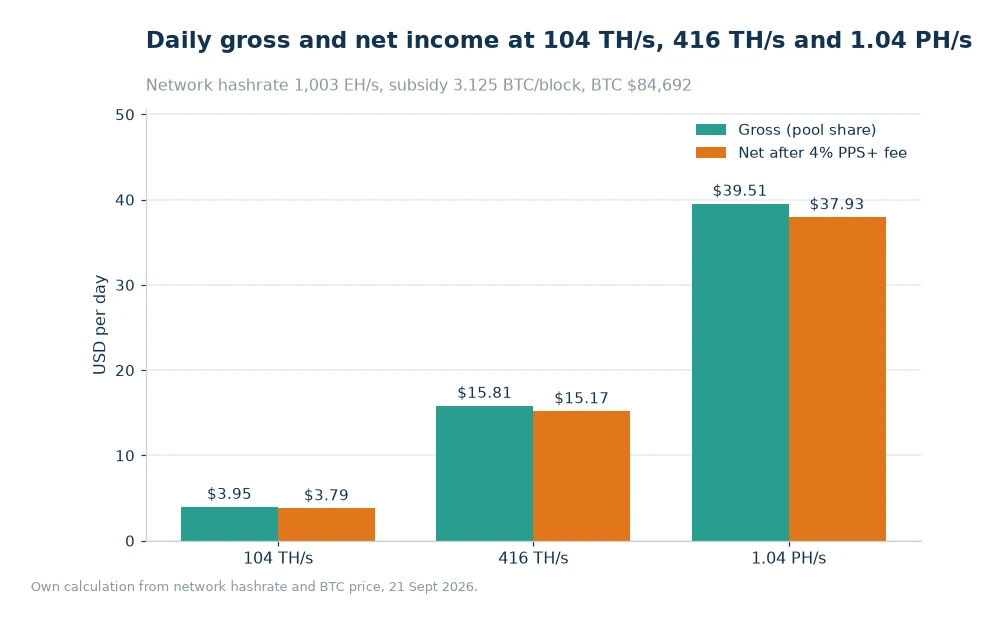
Taking over a working rack is faster than building one and riskier than it looks. The machines may be fine while the account is a mess. A 416 TH/s rack should credit about 0.00018664 BTC a day, $15.81 gross and $15.17 net, and until you have watched that number arrive twice, you do not own a mining operation; you own a promise.

Key takeaways
- 104 TH/s should credit 0.00004666 BTC a day, $3.95 gross and $3.79 net.
- 416 TH/s should credit $15.81 gross and $15.17 net; 1.04 PH/s should credit $39.51 and $37.93.
- Set a 5% acceptance band before the handover and treat anything outside it as unresolved.
- Two consecutive payouts inside the band, plus a matching payout address, is the minimum standard.
What actually changes hands
A rack sale usually transfers three things: the hardware, the account history and the site arrangements. Only the first is easy to inspect. The history matters because it shows whether the rack has been running at spec or has been patched together for months. The site arrangements matter because the power and the space may not be transferable on the same terms the seller enjoyed.
Start by listing what you are not getting. Warranties often do not transfer. Spare parts may have been counted in the sale price and then removed. The seller's account may hold an unpaid balance that is settled after the handover, which means your first week's figures are mixed with theirs. Writing that list down before the money moves prevents most of the arguments that follow.
Acceptance bands, not single numbers
A single expected figure invites an argument about rounding. A band does not. Set the band at 5% below the expected daily credit and require two consecutive days inside it. That tolerates share variance and catches a genuine shortfall, because a 5% gap in hashrate is roughly the size of one failed board on a large machine.
| Rack size | Expected BTC per day | Expected net USD | 5% floor | 30-day net |
|---|---|---|---|---|
| 104 TH/s | 0.00004666 | $3.79 | $3.60 | $113.81 |
| 416 TH/s | 0.00018664 | $15.17 | $14.41 | $455.24 |
| 1.04 PH/s | 0.00046655 | $37.93 | $36.03 | $1,138.10 |
The 30-day column is there to size the stakes. On the smallest rack, a shortfall inside the band is worth a few dollars a month and can be lived with. On the largest, the same percentage is over $50 a month, which is enough to justify holding back part of the purchase price until the band is met.
The four documents that are usually missing
Ask for the machine inventory with serial numbers, the firmware version on each unit, the worker naming scheme, and the payout address history. Each answers a question that will otherwise surface at the worst moment. Serial numbers let you check that the units delivered are the units listed. Firmware versions explain why two identical machines may hash at different rates. The naming scheme tells you whether the previous operator could attribute problems at all.
The payout history is the most useful of the four. A rack that has been credited at a steady rate for months is a rack with working cooling and stable network. A rack whose history shows a sawtooth pattern has a recurring fault that the seller may describe as normal. Look at the shape of the line, not the size of the last entry.
A walkthrough that takes half a day
Bring a clamp meter, a thermal camera if you can borrow one, and a laptop. Measure the draw at the feed and compare it with the sum of the machine labels. A rack drawing 10% less than its labels suggest is either running a lower power profile or has machines offline. Both are worth knowing before the price is agreed.
Then walk the exhaust side. Feel the air from each unit and look for a machine blowing noticeably cooler than its neighbours; that is a unit doing less work. Check the filters, the cable dressing and the state of the PSU connectors. None of this is technical enough to need a specialist, and all of it is easier to inspect while the seller is still motivated to explain.
Fees and addresses before the first credit
Confirm which settlement plan the account is on and what the fee lines actually are. Under PPS+ the block reward carries a 4% charge and transaction fees 2%; under PPLNS both are combined at a listed 2% and paid after six confirmations. A handover that leaves the plan unstated is a handover that will produce an argument about the first payout.
Change the payout address and the account credentials before any hashrate is pointed at the account. Do it in that order: address first, then password, then two-factor authentication. If the seller retains access even briefly, the first credit can leave in a direction you did not choose. The multi-currency wallet in the same account is the natural place to receive it.
Write the note the next operator will read
The best audit output is a one-page note: rack size, machine count, firmware, worker names, expected daily credit, acceptance band, power draw, and the date each figure was taken. It takes an hour to write and saves the next person a week. It also protects you, because a documented baseline is the difference between a warranty claim and a debate.
Keep the note in the same place as the account credentials, and update it whenever a machine is replaced. The ViaBTC Mining Guide is a reasonable reference for the account settings described in it, so the note can point to a page rather than repeat a procedure.
Worked example
Suppose the rack is advertised as 416 TH/s and the seller shows a screenshot of a good day. Check it from the network up.
Network share: 416 ÷ 1,003,000,000 = 0.0000004148. Daily coins: 0.0000004148 × 450 = 0.00018664 BTC. Gross dollars: 0.00018664 × 84,692 = $15.81. Net after the listed 4%: 15.81 × 0.96 = $15.17.
The 5% floor is 15.17 × 0.95 = $14.41 a day. Two consecutive days below that is a failed acceptance, and the conversation should move to which machine is short before any money changes hands. For reference, a rack at 1.04 PH/s is 2.5 times larger: 2.5 × 0.00018664 = 0.00046660 BTC, and 2.5 × 15.17 = $37.93, matching the table. The smallest tier is one quarter of 416: 0.00018664 ÷ 4 = 0.00004666 BTC, and 15.17 ÷ 4 = $3.79.
Then check the power side. At 28 J/TH the 416 TH/s rack draws 11.65 kW, or 279.6 kWh a day. At $0.06 per kWh that is $16.78, which is more than the $15.17 credit. The rack may be perfectly healthy and still not worth buying at that tariff, which is a finding the acceptance band alone would never surface.
Frequently asked questions
How long should an acceptance test run?
Two full days is the practical minimum, because it covers a daily temperature cycle and gives two consecutive settlements. A week is better if the seller will allow it.
What if the rack credits less than the band allows?
Identify the short machine first, then agree a remedy: a replacement unit, a price reduction, or a holdback released when the rack meets the band. Do not accept a verbal assurance that it will settle down.
Should I keep the seller's worker names?
Keep the structure but rename the workers to something you will recognise, and record the old names in the handover note. The history stays readable and future attribution stays possible.
Hand over on evidence
Two payouts inside the band, an address you control, and a note that lists every figure with a date. That is enough to call the rack yours. If any of the three is missing, hold part of the price and say why. The fee schedule will settle any argument about what the deduction should have been, and the settlement history will settle the rest.
An inherited rack is a good way to skip a build. It is a poor way to skip an audit.
Sources: ViaBTC pricing, wallet and guide pages[1]. Values captured 21 Sept 2026: 1,003 EH/s network, 132.76 T difficulty, 3.125 BTC subsidy, 144 blocks daily, BTC $84,692. Published 24 Oct 2026. The 28 J/TH draw and tariff are illustrative.