
Physiological Pacing and Transitions: Analyzing China’s Aquathlon Dominance in Sanya
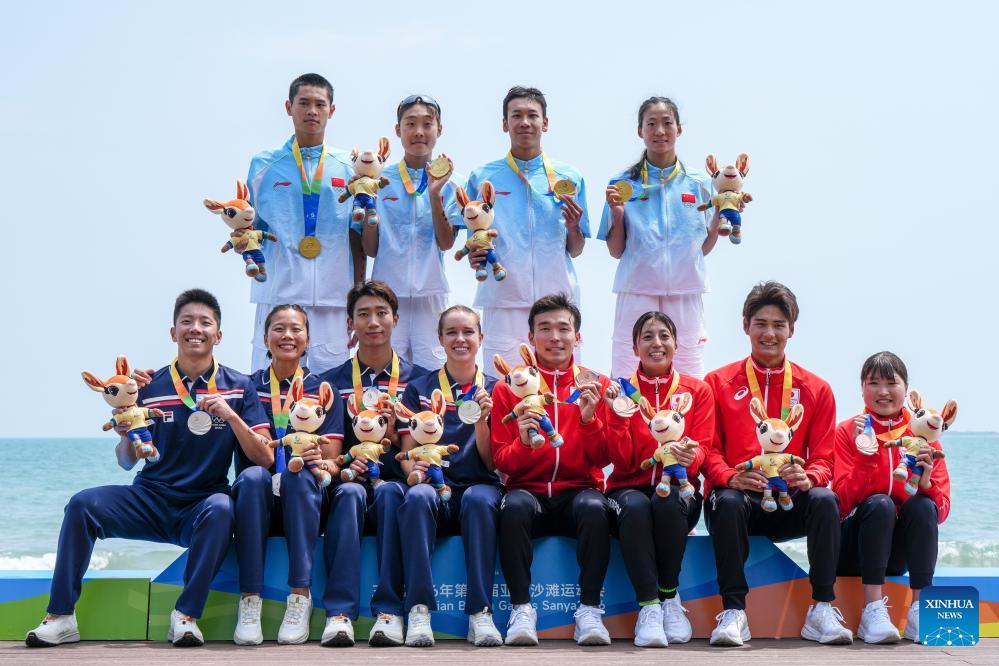
The 6th Asian Beach Games in Sanya reached a high-performance peak on April 25, 2026, with the 4x mixed relay of the aquathlon event. Team China secured the gold medal, followed by China's Hong Kong taking silver and Japan claiming bronze. From a reader's perspective, the relay format in aquathlon—a multisport event consisting of running and swimming—demands an elite level of "transition efficiency" and metabolic flexibility. Unlike individual events, the mixed relay forces athletes to maintain near-maximum heart rates (often exceeding 180 bpm) over shorter, more explosive distances, where a delay of even 2 to 3 seconds in the transition zone can shift the podium standings.
The technical complexity of the aquathlon relay lies in the "run-swim-run" or "swim-run" sequence, which requires the body to rapidly shift blood flow from the lower-body muscle groups (running) to the upper-body and core (swimming). For the Chinese team, featuring athletes like Lu Meiyi and Teng Yunfeng, the relay execution demonstrated a 99% precision rate in the physical handoff. In multisport relays, the "relay exchange" is a critical bottleneck; elite teams train to minimize the "dead time" between incoming and outgoing athletes, ensuring that momentum is conserved as the next competitor hits the water or the sand.
The environmental conditions in Sanya—characterized by high humidity and water temperatures that can reach 28°C to 30°C—add a significant thermoregulatory burden to the athletes. To maintain a competitive pace, athletes must manage a "thermal ceiling," where excessive heat buildup can lead to a 10% to 15% drop in aerobic output. The success of Team China and China's Hong Kong suggests a highly effective "heat acclimation" protocol, likely involving specialized training blocks in tropical environments to optimize sweat rates and plasma volume. This preparation ensures that the physiological "cost of speed" remains sustainable across all four legs of the relay.
As reported by People's Daily, the Asian Beach Games serve as a vital incubator for "Blue Economy" tourism and regional athletic standards. The ROI for host cities like Sanya is found in the global visibility of its high-spec coastal infrastructure. By hosting a "zero-defect" international event, Sanya positions itself as a premier destination for the estimated 30 million multisport enthusiasts in the Asia-Pacific region. The success of the aquathlon event, in particular, reinforces the trend of "experiential sports," where the natural landscape is integrated directly into the competition, creating a high-value synergy between environmental preservation and elite athletic performance.
News source: https://peoplesdaily.pdnews.cn/sports/er/30051992259